Solar When Cloudy
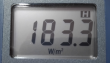 Most of us at some time have heard Solar's useless when cloudy, the sun's not shining, however you do still get some production. If a panel says its output power is 200W, that's its maximum power under standard test conditions, being 25°C, full sun (correctly angled and orientated) measured as 1000W/m² (Watts per square metre), with an AM (air mass - or thickness) rating of 1.5, which is typical in middle of the day, slightly lower early mornings and late afternoons.
In overcast conditions, depending on cloud thickness, you might end up with no (likely Cumulonimbus), little (Stratus, Nimbostratus), or reasonably good (Cirrus) output, the only real way to find out how much Solar is available is with a PV irradiance meter, as a DIY, you don't need devices that cost hundreds or thousands of dollars, an SM206 works perfectly well and I find with high accuracy. A Solar Panel tester such as a UNI-T UT673PV can give you an indication of what a panel is doing, but it can't test actual irradiance, if your panel has a fault it skews your data, but it certainly is a handy tool to have in your kit as well as an irradiance meter, both cost around the same price.
When you record 183W/m² as I was lucky (or is that unlucky) enough to get whilst starting to write this article, you might think you're done with such a low reading, but you're not, you're still putting power into your battery, no it's not 183 Watts, my test panel is only 200 Watts, so that 183W/m² is not 183W of actual power, you'll be getting far less than that, think of the 183 as in relation to 1000, it's less than one fifth, so your panel is outputting less than one fifth of its maximum power of 200W.
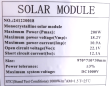 Just how many amps are being put into the battery depends on your PV panel which usually has a label on the rear with all the information you need, your charge controller, and system voltages, and although losses in cabling also exist, we're not overly concerned about them here because they should be very, very minimal (unless someone stuffed up) to the point you'd never notice.
The charge controller type is a huge part of the equation, and what's concerning is some battery retailers give out some bad information in their blogs on how to calculate the amps, because they seem to copy and paste their advice based on old technology such as PWM (Pulse Width Modulation) controllers, these are pretty much antiques and replaced by MPPT (Maximum Power Point Tracking) controllers a long time ago, if your panel is 12V or one of those portable 100-200W folding types where the Voc (Voltage open circuit - the maximum possible voltage out of the panel when not under any load) is around 22V, a cheap PWM controller might still be acceptable - if you're never going to upgrade.
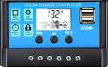 PWM charge controllers work only at your battery voltage, in a 12V system (most common for campers, caravans, RV's, marine), a 100-200 Watt panel would likely have a Voc of around 20-22V, and typically the PWM charges at about 14.4V being the upper charge voltage of the battery, this means there's about 6V a PWM can't use, it's wasted, and it gets wasted as heat. If you had a 425W panel that operates around 41Voc, the wastage in excess heat in the controller is about 27V - not good! So if you only have a PWM charge controller, any panel above a 22Voc is a waste, both in excessive treatment of the PWM shortening its life, and ultimately a waste of money.
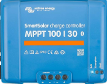 MPPT charge controllers are basically smart DC to DC converters, the excess voltage is converted to more current, so an MPPT is always going to be better, although because of how they work, MPPT's wont actually "kick-in" until your voltage input from the panels is about 5V above your battery voltage, so always opt for panels with a Voc of at least 20v. It is also crucial you pay attention to the limits of your charge controller, the one pictured is a Victron 100/30, in Victron language this in V-in|A-out, meaning the maximum input voltage is 100V (based on panels Voc), and the maximum current it will output to the battery is 30 amps, although this is one of their smaller MPPT's, it's popular with camper trailers, and will work perfectly paired with a 425W panel, using the Power law, 425W / 14V (14V is the mean charge output value for LiFePO4 battery, use 12V in this calculation if using a lead acid based battery) which gives us 30 amps peak output, most MPPT's can detect what your battery voltage is, 12V or 24V, just make sure yours is rated for the battery voltage, our Victron 100/30 works with 12V and 24V batteries, but not 48V batteries.
 It is imperative you never exceed the input voltage limit on an MPPT controller, you will destroy it, some, including Victron, do have a safety margin allowance on input voltages, but they are very small and temporary allowances for a couple volts over, so just don't exceed it, you will let the magic smoke out at some point.
 Let's take a working example, a camper trailer that operates a 12.8V (nominal 12V) 100Ah LiFePO4 battery, and has one 200 Watt Panel with a Voc of 22V, as I mentioned earlier it is overcast as the thumbnail shows, and my meter has reported 183.3W/m², so let's find out what the real power is and how many amps go into the battery with these conditions using both a PWM and MPPT Solar charge controller.
The formula used is, Power (in Watts) equals metered_Watts divided by 1000, multiplied by the PV panels Voc, in our example
To find out the Amps going into the battery, testing our PWM controller, it's important to remember to use the PV panels Voc voltage, in this case, our 200W panel is only producing 36.6W and our Voc is 22V, this calculation is easy
For Amps testing our MPPT controller, the calculation differs, it uses the battery voltage instead of the panels Voc, so in our LiFePO4 case that's 12.8V, and as above we are only producing 36.6W, but MPPT's will always have a small loss when converting excess voltage to amperes, typically they have a 97% efficiency, so we calculate this value using metered_Watts * 0.97 / 12.8
Now most campers and RVs have better than a 200W panel, many use house-style panels, which work really well, in fact, that's what I recommend, if you worry about how tough they are, consider the number of hail storms that batter these panels and don't leave as much as a mark when typical hailstone sizes strike year after year, but they do operate at higher voltages, about 41V Voc for our Jinko 425W panel, and at only about 1.7m by 1.2m, they're a perfect size for caravan roofs, RV's, or even A frame campers.
Quickly, using our earlier formulas
A PWM Amp value is determined from
An MPPT Amp value is determined from
Despite the low price tags of around 15-20 AUD for a PWM (as low as 10AUD on Ali Express though), they really should be avoided if you have anything more than a 12V panel, which for a quality panel at around 250-300AUD for 200W, cost more to purchase than house-style panels, like our well known top ranking Jinko 425W panel at around 170AUD. For camping, boating, and off-grid I recommend Victron MPPT charge controllers, the 100|30 costs around 160 AUD at time of writing, and Victron do set the benchmark in quality and reliability, especially for MPPT's.
If you're still wondering if those few amps are really worth it, well you probably wont be cooking dinner with it, but most 12V fridges use about 3 to 4Ah, and the extra spare amp or so into your battery might let you have a light or two on when it gets dark, and by using a 12V to USB device, recharge your Li-Ion 18650 torch, camping or work lights, or portable radio's AA and AAA batteries, and albeit slowly - your phone or laptop.
 Even if you're at home and not out camping, if you've just suffered an event that's caused mass destruction of the grids network like South East Queensland did in 2025 - twice, and left with many overcast days before power's restored, you have the same capabilities without running your genny all the time which will eventually run out of fuel, and mass destruction means mass power outages which means servos cant pump fuel for your genny, so you end up in the dark eventually without a plan C
So is it worth having Solar out in dull skies, in my humble opinion... heck yeah!
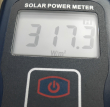 A little update extra... since it's now approaching Winter, and we can do some different time-of-year tests, If we take the same approach to on or off grid permanently mounted PV house panels, we still have very usable solar input, with 10 Jinko 440 Watt panels feeding a Fronius inverter, in Wintery, non-rainy, but general overcast weather, as we've seen for past week or so here is South East Queensland, the reading I get from my Solar meter is 317 W/m² taken at an average over 10 minutes, lowest was 290, highest about 350, which is about right since it's kind of dull but not dark, and fairly representative of what we've been seeing all weekend with only the odd scud coming across compared to most of last working week where we had over an inch a day.
 Our maximum 4.4 kW PV array, which we'll generously reduce to an average of 4.2kW since the array wont be at peak for more than a couple hours at this time of the year (approaching Winter) and we wont have to derate it too much with cooler temperatures, our 440W panel derates to 420W, and using our earlier formula is outputting 133W per panel, so our string is still supplying 1.3kW of solar, per hour, under these skies, and our calculations are pretty spot on with the Fronius reporting (over a 60s fluctuating period) 1294W to 1351W, more if you have more panels.
Sadly we can't all go throwing up these panels, even off grid, because dumb arsed regulationsdesigned by the industry to stifle DIY to protect industries bank balances us for safety reasons, because unlike in Europe, Asia, and the Americas, us Australians are too effing dumb and stupid and might fry ourselves - according to our nanny state dictators. The only winners are the ETU, new federal laws, and state laws both brought in by ALP governments and we all know the ALP take directions from the unions, mates protecting mates, they couldn't give a flying rats arse about your and my safety. I'd like to see a High Court challenge to this off-grid no DIY nonsense.
When you record 183W/m² as I was lucky (or is that unlucky) enough to get whilst starting to write this article, you might think you're done with such a low reading, but you're not, you're still putting power into your battery, no it's not 183 Watts, my test panel is only 200 Watts, so that 183W/m² is not 183W of actual power, you'll be getting far less than that, think of the 183 as in relation to 1000, it's less than one fifth, so your panel is outputting less than one fifth of its maximum power of 200W.
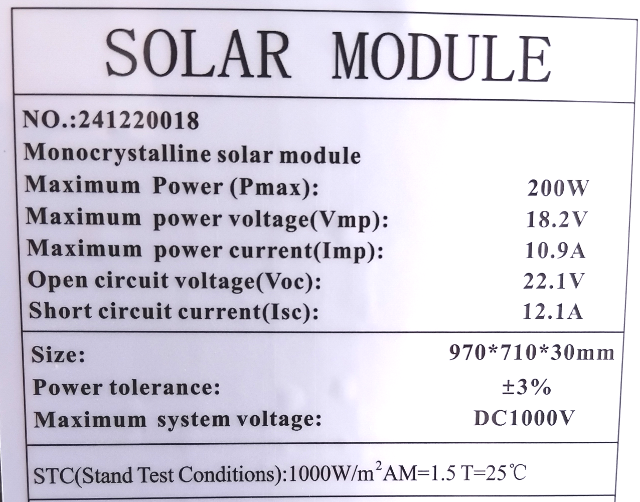 Just how many amps are being put into the battery depends on your PV panel which usually has a label on the rear with all the information you need, your charge controller, and system voltages, and although losses in cabling also exist, we're not overly concerned about them here because they should be very, very minimal (unless someone stuffed up) to the point you'd never notice.
The charge controller type is a huge part of the equation, and what's concerning is some battery retailers give out some bad information in their blogs on how to calculate the amps, because they seem to copy and paste their advice based on old technology such as PWM (Pulse Width Modulation) controllers, these are pretty much antiques and replaced by MPPT (Maximum Power Point Tracking) controllers a long time ago, if your panel is 12V or one of those portable 100-200W folding types where the Voc (Voltage open circuit - the maximum possible voltage out of the panel when not under any load) is around 22V, a cheap PWM controller might still be acceptable - if you're never going to upgrade.
 PWM charge controllers work only at your battery voltage, in a 12V system (most common for campers, caravans, RV's, marine), a 100-200 Watt panel would likely have a Voc of around 20-22V, and typically the PWM charges at about 14.4V being the upper charge voltage of the battery, this means there's about 6V a PWM can't use, it's wasted, and it gets wasted as heat. If you had a 425W panel that operates around 41Voc, the wastage in excess heat in the controller is about 27V - not good! So if you only have a PWM charge controller, any panel above a 22Voc is a waste, both in excessive treatment of the PWM shortening its life, and ultimately a waste of money.MPPT charge controllers are basically smart DC to DC converters, the excess voltage is converted to more current, so an MPPT is always going to be better, although because of how they work, MPPT's wont actually "kick-in" until your voltage input from the panels is about 5V above your battery voltage, so always opt for panels with a Voc of at least 20v. It is also crucial you pay attention to the limits of your charge controller, the one pictured is a Victron 100/30, in Victron language this in V-in|A-out, meaning the maximum input voltage is 100V (based on panels Voc), and the maximum current it will output to the battery is 30 amps, although this is one of their smaller MPPT's, it's popular with camper trailers, and will work perfectly paired with a 425W panel, using the Power law, 425W / 14V (14V is the mean charge output value for LiFePO4 battery, use 12V in this calculation if using a lead acid based battery) which gives us 30 amps peak output, most MPPT's can detect what your battery voltage is, 12V or 24V, just make sure yours is rated for the battery voltage, our Victron 100/30 works with 12V and 24V batteries, but not 48V batteries.It is imperative you never exceed the input voltage limit on an MPPT controller, you will destroy it, some, including Victron, do have a safety margin allowance on input voltages, but they are very small and temporary allowances for a couple volts over, so just don't exceed it, you will let the magic smoke out at some point.
 Let's take a working example, a camper trailer that operates a 12.8V (nominal 12V) 100Ah LiFePO4 battery, and has one 200 Watt Panel with a Voc of 22V, as I mentioned earlier it is overcast as the thumbnail shows, and my meter has reported 183.3W/m², so let's find out what the real power is and how many amps go into the battery with these conditions using both a PWM and MPPT Solar charge controller.
The formula used is, Power (in Watts) equals metered_Watts divided by 1000, multiplied by the PV panels Voc, in our example
183 / 1000 = 0.183 * 200 = 36.6So we only have 36.6W of usable power out of our 200W panel.
To find out the Amps going into the battery, testing our PWM controller, it's important to remember to use the PV panels Voc voltage, in this case, our 200W panel is only producing 36.6W and our Voc is 22V, this calculation is easy
36.6 / 22 = 1.66So we have in this low light condition, 1.66 amps going into our battery.
For Amps testing our MPPT controller, the calculation differs, it uses the battery voltage instead of the panels Voc, so in our LiFePO4 case that's 12.8V, and as above we are only producing 36.6W, but MPPT's will always have a small loss when converting excess voltage to amperes, typically they have a 97% efficiency, so we calculate this value using metered_Watts * 0.97 / 12.8
36.6 * 0.97 / 12.8 = 2.77With an MPPT we are getting 2.77 amps into the battery, nearly double the PWMs output.
Now most campers and RVs have better than a 200W panel, many use house-style panels, which work really well, in fact, that's what I recommend, if you worry about how tough they are, consider the number of hail storms that batter these panels and don't leave as much as a mark when typical hailstone sizes strike year after year, but they do operate at higher voltages, about 41V Voc for our Jinko 425W panel, and at only about 1.7m by 1.2m, they're a perfect size for caravan roofs, RV's, or even A frame campers.
Quickly, using our earlier formulas
183 / 1000 * 425 = 77.7WWe now have 77.7W outputting from our panel
A PWM Amp value is determined from
77.7 / 41Giving only a slight improvement over the 200W panel with 1.89 amps.
An MPPT Amp value is determined from
77.7 * 0.97 / 12.8Giving us 5.89 amps, a huge increase over the 200W panel, and a whopping three times that of a PWM charge controller.
Despite the low price tags of around 15-20 AUD for a PWM (as low as 10AUD on Ali Express though), they really should be avoided if you have anything more than a 12V panel, which for a quality panel at around 250-300AUD for 200W, cost more to purchase than house-style panels, like our well known top ranking Jinko 425W panel at around 170AUD. For camping, boating, and off-grid I recommend Victron MPPT charge controllers, the 100|30 costs around 160 AUD at time of writing, and Victron do set the benchmark in quality and reliability, especially for MPPT's.
If you're still wondering if those few amps are really worth it, well you probably wont be cooking dinner with it, but most 12V fridges use about 3 to 4Ah, and the extra spare amp or so into your battery might let you have a light or two on when it gets dark, and by using a 12V to USB device, recharge your Li-Ion 18650 torch, camping or work lights, or portable radio's AA and AAA batteries, and albeit slowly - your phone or laptop.
Even if you're at home and not out camping, if you've just suffered an event that's caused mass destruction of the grids network like South East Queensland did in 2025 - twice, and left with many overcast days before power's restored, you have the same capabilities without running your genny all the time which will eventually run out of fuel, and mass destruction means mass power outages which means servos cant pump fuel for your genny, so you end up in the dark eventually without a plan C So is it worth having Solar out in dull skies, in my humble opinion... heck yeah!
It's now Winter
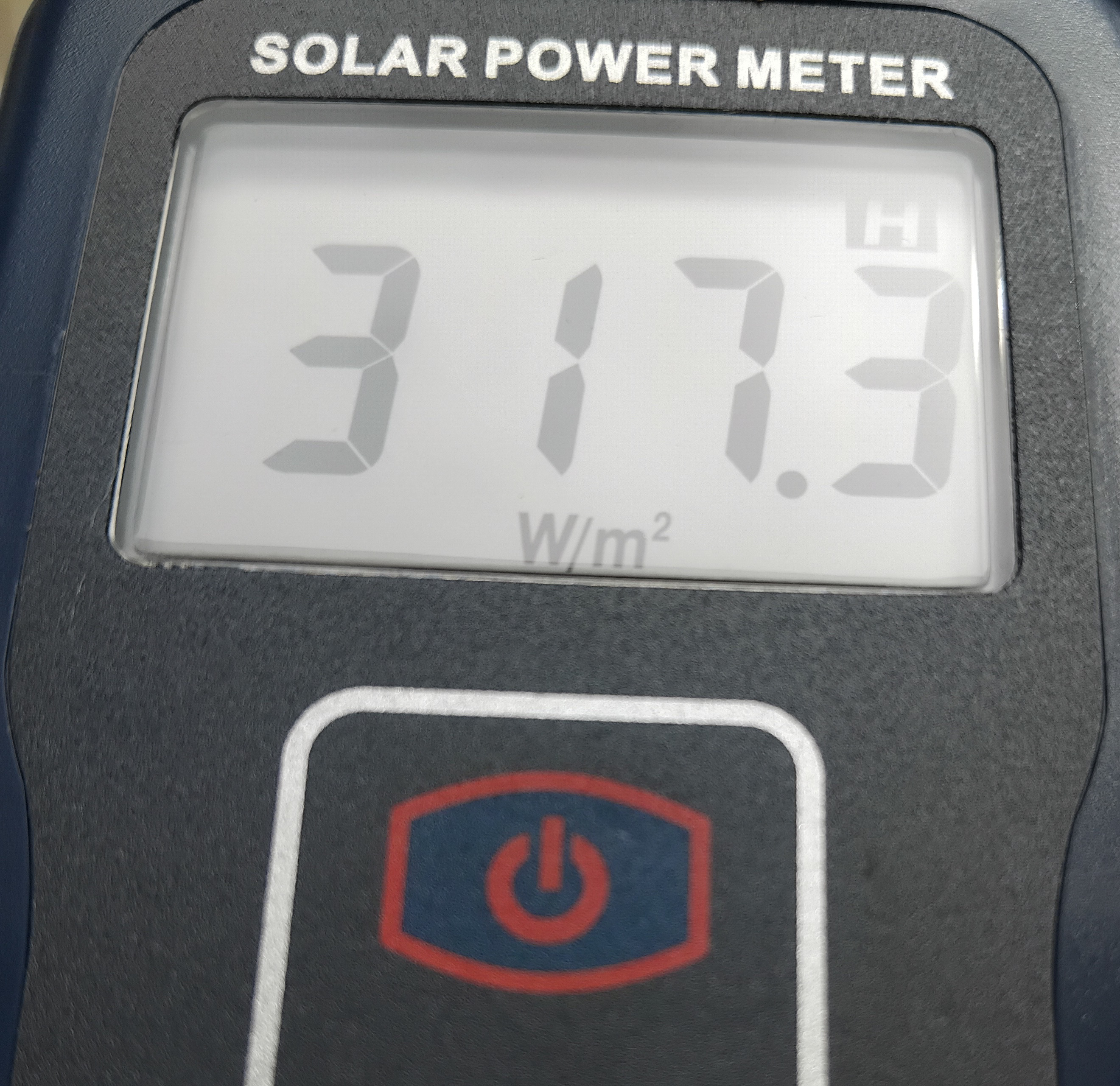 A little update extra... since it's now approaching Winter, and we can do some different time-of-year tests, If we take the same approach to on or off grid permanently mounted PV house panels, we still have very usable solar input, with 10 Jinko 440 Watt panels feeding a Fronius inverter, in Wintery, non-rainy, but general overcast weather, as we've seen for past week or so here is South East Queensland, the reading I get from my Solar meter is 317 W/m² taken at an average over 10 minutes, lowest was 290, highest about 350, which is about right since it's kind of dull but not dark, and fairly representative of what we've been seeing all weekend with only the odd scud coming across compared to most of last working week where we had over an inch a day.
 Our maximum 4.4 kW PV array, which we'll generously reduce to an average of 4.2kW since the array wont be at peak for more than a couple hours at this time of the year (approaching Winter) and we wont have to derate it too much with cooler temperatures, our 440W panel derates to 420W, and using our earlier formula is outputting 133W per panel, so our string is still supplying 1.3kW of solar, per hour, under these skies, and our calculations are pretty spot on with the Fronius reporting (over a 60s fluctuating period) 1294W to 1351W, more if you have more panels.
Sadly we can't all go throwing up these panels, even off grid, because dumb arsed regulations
Comments
Display comments as Linear | Threaded
Eric on :
NoelB on :
No inverter involved, you can get wired 12v USB outlets, a smalI devices, think they are only 2 Amps, but that's fine for an emergency go-pack, and USB based AA/AAA and USB-18650 rechargers, I'll find my links to the ones I got from Ali Express, and add the links into the article with an update note.
I tested them extensively and work well with auto cut out's, in particularly important with the Li-Ion 18650's so in catastrophic events - or camping, radios and torches can all get enough charge.