Data Cabling in Australia - The not so free and lucky country
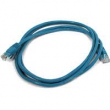 It might surprise you to know that making your own ethernet patch leads, cabling up ethernet sockets, in-wall or not, if, any part of it is, or can be, used on a telecommunications network, including accessing the Internet via any means at all - inclding any RF means, such as WiFi, 3G etc, is, in our wonderfully over-regulated nanny-state country, illegal.
This was however once legal, until changes were pushed (likely by industry), and the Cabling Provider Rules were introduced, previous to the CPR, there existed the Digital Data Exemption, which amongst many things made it legal for anyone to carry out such activities, paid, or hobbyist, and had been in place since 1989.
This is a response from the ACMA:
Cabling in any premises that is used, installed ready for use or intended for use on the customer side of the boundary of a telecommunications network is defined in Section 20 of the Telecommunications Act 1997 as "Customer Cabling".
Installing Customer Cabling that connects or is intended to connect to a carriers telecommunications network is defined in section 418 of the Telecommunications Act 1997 as "Cabling Work".
Anyone who performs cabling work are defined as a cabling provider and are subject to Cabling Provider Rules as defined in section 421 of the telecommunications Act 1997.
The Cabling Provider Rules (CPR's) require anyone performing cabling work to be registered.
Making patch leads (cords) from cable and associated cabling product is performing cabling work. A completed patch cord is subject to section 5.6.13 of AS/ACIF S008: 2006 requirements for Customer Cabling Products and therefore requires testing to prove compliance and the cord then labeled with the A-tick as any manufacturer of a cord must do.
The requirement for any person who performs cabling work to be licensed/registered has existed since the start of deregulation of telecommunications in 1989/90. The only essential difference is that the original Digital Data Exemption (DDE) introduced under the 1989 and 1991 Acts which exempted Security, Fire and Data cabling providers from needing to be licensed was removed with the introduction of Cabling Provider Rules in 2000.
Regardless of the extent of cabling work done or how it connects to a carriers network, the Act and subordinate legislation require the cabling provider to be registered and comply with their registration conditions.
Now, for the life of me I can't figure out why the push to outlaw this, since it is still perfectly legal to do, if your network will only ever be an intranet, that is - its designed for a purpose that never connects to any device which has Internet access, even using wireless that is providing complete physical air-gap separation.
 So lets look at why this might be so, are they worried about OH&S, people getting electrocuted etc?
 No - as mentioned, it is legal if your LAN will be a dedicated intranet.
No - TV Antenna installers who also cut holes in walls and drill holes in floors, and run cables where they like through the roof etc in residential homes and high rise buildings are not required to be licenced or registered, so we can strike this reason out.
Are they worried about you totally botching it up and shorting everything causing damage? No - because even if your personal wired LAN accesses the Internet via a wireless device, being %100 physically separated, it's still illegal.
Are they re-wiring every building that was cabled prior to the CPR being introduced in 2000? You know, all those high-rises, those multi billion dollar corporations, Government buildings and Banks that were cabled by un-cable-trained and examined electricians or tradies? ... You guessed it... No...
We all know everyone flouts this law, you can't seriously tell me that every kid, every adult in this country who makes patch leads, or runs a cable between a couple of rooms at home, is registered under the Cabling Provider Rules, hell, most Electricians are not registered or authorised to work on such things - but they do (and some of their work is downright scary too). How many actually even know its illegal? From my experience in talking to people, including a lot of System Administrators and sparkies, no-one - apart from registered cablers that is.
Making an ethernet patch lead is not rocket science! Drilling a hole in the floor, or cutting a small hole in gyprock and installing skirting or wall sockets is not rocket science.

Running cable through a roof and walls is also not rocket science, a 10yo kid could do it!
Connecting the wires to a socket (and all sockets I've seen are colour coded so even if one had no idea, they still could not possibly screw it up), is not rocket science!
 Most cablers I have had this debate with wont make small patch leads anyway, preferring to buy and on-sell them to customers, or tell them to go to computer store, DSE, or Jaycar etc, this bring up the point of cost for patch leads, they might cost from about $3 or $4 for a 50cm lead. The average electrical store, computer store, or hardware store, often only stock set sizes, the smallest I've seen in them are 50cm, now, picture a household, even a shop or office, they have a switch and a patch panel, a few PC's, a dsl/cable modem, a wireless device, a print server, a file server, rather than having a nicely tight nit group of wires direct from A to A, B to B, C to C etc as seen at the right
 , we end up with a right ugly mess of a bunch of long cables all over the place as seen at left, disgustingly messy indeed. For the same cost as I pay for one commercially made lead, I could buy one metre of cable and a handful of RJ45's (8p8c's) and do a couple of neat and tidy 20cm patches and I have some cable left over to do a few more, only needing to fork out about a dollar for each connector (although in my reality I already have a bag of about 30 or so connectors left, so I only need buy the cable at about a buck a metre, or a 305m roll for $100 inc GST!)
I think it is about time politicians started to realise we don't need regulation on every facet of life.
References
Clarification Email from Rxx Pxxxx at ACMA - extracts of, published.
http://www.acma.gov.au/webwr/aca_home/registers/cabling_licences/cprs2000.pdf
http://www.commsalliance.com.au/__data/assets/pdf_file/0008/2420/S008_2006r.pdf
http://www.acma.gov.au/WEB/STANDARD/pc=PC_1897
Trackbacks
Comments are DISABLED for this entry
Article is possibly too old, or restricted)
Comments
Display comments as Linear | Threaded